
Types of hand-woven carpets
Types of hand-woven carpets
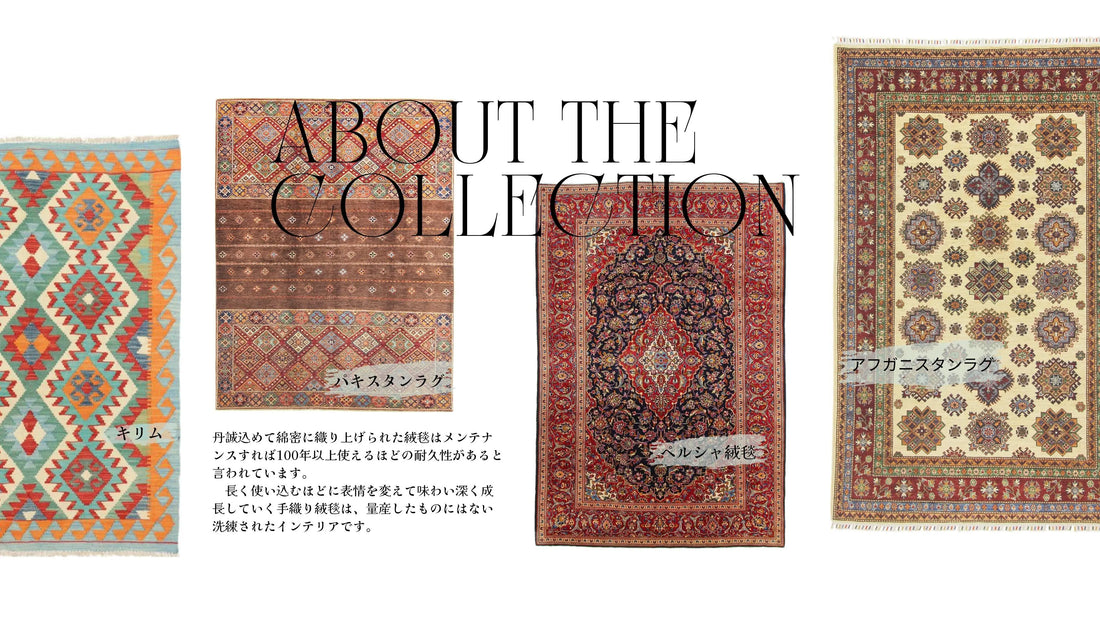
Handwoven carpets have a long history, and each has its own background and characteristics. Here we will roughly categorize carpets and give a brief introduction. Please use this as a reference when choosing a carpet.
What is a Persian carpet?


High-quality antiques made in famous production areas are valuable as physical assets and are sometimes purchased for investment purposes. Persian hand-woven carpets have a long history and intricate designs that are hard to believe are hand-woven, making them highly valued as works of art, and they remain popular worldwide to this day.
What are Pakistani carpets?
The history of Pakistani carpets dates back approximately 500 years. It is said that they began when the ruler of the empire at the time had rugs made for the royal palace. Pakistani carpets are densely woven, extremely durable, and can be cared for at home, making them practical and suitable for many years of use.


What are Afghan carpets?
Carpets woven in and around Afghanistan are characterized by muted colors such as black, deep red, and brown. The soft, firm wool pile is durable and breathable, making them comfortable to wear all year round.

↑Khwaja roshnai is a carpet with a design featuring small, continuous depictions of the emblem of the Turkmen tribe called "Gul," and its simplicity allows you to fully appreciate the fine weaving techniques.

Among the most popular are Khal Mohammadi and Khwaja roshnai, which are handwoven by the Turkmen people of northern Afghanistan. Both have a simple number of colors, allowing you to enjoy the luster of the wool surface and the depth of color.
Handwoven wool carpets from Ghazni

Ghazni province is one of the most important wool-producing areas in Afghanistan, and the region's climate and geographical conditions contribute to the cultivation of high-quality wool.
Ghazni wool has been valued since the 19th century, and the traditional dyeing techniques developed by artisans at that time are still used today.
What is Kilim?
Kilims are flat-woven carpets that are primarily produced in Turkey, Iran, and Afghanistan. They are thin, have no pile, are highly breathable, and have a smooth texture. They are treasured locally; if they get dirty, they are washed, and if they tear, they are repaired or remade into bags. As they can be used on both sides, they can be used not only as rugs, but also hung on furniture, used as partitions, or hung on walls to enjoy as a painting.

Kilims have a history of over 1,500 years. "Old kilims," woven several decades to a hundred years ago, are woven using a different method than the "new kilims" woven today, and were painstakingly made by hand-spinning the threads. In recent years, industrialization has led to a sharp decline in the number of artisans, making them increasingly rare. "New kilims" are characterized by their modern designs and vibrant colors, and come in a wide variety of sizes and patterns, making it easy to find a piece you love.

What is Gabbeh?
Gabbeh is a type of carpet loosely woven with thick, hand-spun wool yarn. Made with stiff wool, it is thick and fluffy. Its simple yet charming colors are also a feature.
It is recommended as a cushion or chair mat, or as an item to decorate your car seats.
The patterns are filled with wishes and prayers for happiness, and the meaningful designs, such as the tree of life that represents longevity and health, and the sheep that represents abundance, make them great gifts.
